
Today was one of those days that made me wonder if I focus too much on WHERE God wants me to be, when my focus and desire needs to be to be used by God WHEREVER I might find myself.
Dick and I both write about “Godincidents,” and I do believe that God places divine appointments in our paths. But sometimes I think I get out of balance, thinking that if I weren’t on in exactly the right place at the right time (the time and place He ordained), that the ministry I get to do would not have happened. How egotistical! As if God could not do His work without me! I’m lucky He lets me be a part of what He is doing in the lives of His people.
More and more I am beginning to believe that He will use us wherever we are, if we are open to His Spirit guiding our steps, and even more willing to place each ministry opportunity before Him for HIS go ahead before jumping in to meet a need.
Yesterday, as we were walking through the park with some of the Hermano Pedro kids, a man starting following us. Finally, he worked up the courage to speak to Dick—though, since he was speaking Spanish, really didn’t help him very much. Dick pointed him to me, and we discovered that this man had a ten year old daughter who had had a stroke at birth. She had a wheelchair, but he felt it wasn’t right for her. Could we possibly get her a new one?
He walked with us back to Hermano Pedro, and on the way we discovered that it just so happened that his daughter would be coming with their family to Antigua tomorrow. It just so happened that Dick had planned to be at the orphanage, too. Plans were made to meet up with them today.

And we did. Maria de los Angeles was a bright, beautiful young lady who was more than excited to get a new wheelchair. You could feel how much her parents loved her, how well they cared for her (she receives therapy twice a week at Fundabien in the capital, and also attends school). Her brother, sister, and cousins all enjoyed her.
Dick had been able to get an appropriate chair from the Hope Haven factory (it just so happened that some of their staff was coming to the orphanage this morning) and was able to structure a chair that will better support Maria and allow her some freedom to move on her own. While Dick worked on the chair, I got to show her family around the children’s ward at Hermano Pedro—they were very interested in each of the kids and their unique stories.

None of this is particularly remarkable, except for the fact that both Dick and I had been struggling yesterday with whether or not we should take kids to lunch, or should we be other places where we were more needed. As I sit back and reflect on this, I can’t help but think of the sign my brother game me before I moved to Guatemala:

Each day here, I learn this to be more true. . .He knows where we need to be, and He doesn’t keep it a secret.
Down here, wherever we look we see need. I sometimes joke (sarcastically, I’m afraid) at missionaries down here who say they are waiting for God to give them a ministry. I laugh that they can go out in the street and throw a rock, and wherever it lands, that’s a place they can do ministry. And this is to some extent the truth. There are so many needs I could work 24/7 at saving everyone and still never make a dent in the deep poverty, both material and spiritual, that I meet each day.
So I’m trying to relax a little. Sure, I still ask God’s direction in where I should go, but more often I’m asking for His direction in discerning what I should do where I find myself. I’m stressing less about doing the “right” thing, and trusting more that the people He places in my path are the ministry He has for me in this moment.

Should I travel with Dick and the boys to Santa Rosa, or should I stay in Antigua and spend time with the family for Easter? How much time should I spend at Hermano Pedro with the kids who didn’t get to go home? Should I go to Santa Maria to do exercises with Mirna, or should I take Doña Matie out to lunch?
So I ask God. And sometimes He is very clear about what He wants me to do. I knew, beyond any shadow of a doubt that He had invited me to Guatemala. No one and nothing could convince me otherwise. So I came, and it was easy, because He was so clear and I was so convinced.
Other times, He seems silent. I don’t really know which of two good things I should pursue. I believe in those times, there are opportunities for ministry in both choices, and it doesn’t matter which one I choose, He will use me in whichever environment I find myself.
Most often, though, I have a “prompting” in my heart, mind, and soul that I should pursue one opportunity over another. It’s not clear, but it’s like a strong inclination. I’m not talking here about doing what I FEEL like doing. . .too often I don’t FEEL like doing anything. I’m talking about feeling gently “pushed” in one direction over another. Sometimes “pushed” in a direction I really don’t want to go. . .
 So what do I do when I’m not sure? I do SOMETHING and look for the reactions as I take each step forward. And it seems that, whenever I desire what I do be glorifying to God, it is. Those things that I initially didn’t feel like doing becomes deeply satisfying. He surprises me almost everyday at what I am able to do, when I rely on His leading and His strength. If I overthink it, becoming obsessed with doing the right thing in the right way, I become paralyzed, doing nothing.
If I take the one step, He always seems to show me the next one. As a good friend has told me, you can’t steer a car when it’s not moving. God can’t lead us when we stand immobilized, worry too much about doing the right thing in the right way. Do your best and He will do the rest!


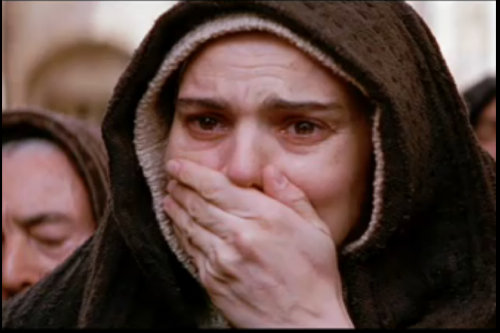 I can’t imagine the torture of this mother as she watched Jesus walk to Calvary. The torment she experienced as she stood helplessly by His side and watched His life drip out of Him on the cross. She freely chose to be there when she could just as easily have hidden at home and protected herself from this pain. But she was there out of love, willing to endure whatever was necessary to show her love of Jesus. This was confirmed for me in an interesting way a few moments later when another statue came


 This time it was different, though. We were hours away from Antigua, which is a couple of hours from their home near the coast. This time the family would have to handle things on their own. We did tell them that we would call Carlos, the office manager for Bethel Ministry, and ask him to deposit funds in her account so she should take Herlindo to the clinic.


